Showing posts with label Reviews. Show all posts

Tuesday, 8 January 2013

Persona 4 The Golden review - Shadow World


As the years have passed by, the JRPG has fallen far in the eyes of gamers. From being the must have, killer app that every platform needed (love it or hate it, Final Fantasy VII was one of the most important games in the history of the Playstation), they've now been reduced to curios, outshone commercially by their western counterparts and appealing only to a small niche audience. Critics have lambasted them for generic design, poor stories and weak dialogue, and it certainly seems that barring some exceptions the overall quality of games has diminished as the years have gone by.

One of the exceptions to this downward trend has been the Shin Megami Tensei games, not so much in being niche products (part of the appeal is that they are very niche) but in the fact they've injected some fresh ideas and concepts into the genre.  Dark, heavily based on existing mythologies, and normally set in modern day urban environments, they've become something of a banner series for those who insist the JRPG can still be relevant. In particular, the Persona sub series, after a successful reintroduction to the west in 2006 with Persona 3, has become a fan favourite. Persona 4 followed in 2008 and though it emerged years after the PS2 had been rendered an outdated console, it was widely regarded as a superb game. Over time its legend has grown to the point that many now regard it as one of the greatest RPGs ever made. Needless to say then that when Atlus announced a remake for PS Vita, complete with new content, expectations were high. Whereas the original Persona 4 had sailed under most people's radars, this new version arrives with 4 years of hype behind it, along with a duty to shoulder a platform which lacks decent software to put it kindly.

Is it up to the challenge? Absolutely.

Thursday, 5 March 2009

Mini Review - Prince of Persia: Epilogue

Photobucket

The Good
- Still beautiful to look at and to control.  Challenge level has been significantly raised, some new sections require superbly tricky timing and acrobatics. A partial return to the 'large puzzle room' philosophy of The Sands of Time (one room in particular). Solid level throughout. 

The Bad - Short. Nothing too new here. Dark design (though necessary from a plot standpoint) dulls the game's beauty somewhat. Practically no narrative progression.

The Ugly - Boss recycling, which the main game was guilty of already, reaches irritating new heights here. Particularly bad to see The Warrior, the most tiresome boss from the main game reused extensively.

Monday, 23 February 2009

We got next - Street Fighter IV review


Photobucket

Street Fighter IV has a lot to live up to. It's the first 'numbered' game in the legendary franchise since 1999's Street Fighter III: Third Strike, a game that was widely considered to be the ultimate 2D fighter, one of the most beautifully balanced and technically proficient fighting games ever made. It was also widely considered to require expertise beyond the ken of mere mortals, and although this could produce some truly memorable moments, its complicated parry defense and super arts combo system made it a game to be intently studied rather than picked up and played. In this, Capcom failed to reproduce the mentality behind the legendary Street Fighter II, which appealed to all ages, skills and gamers. Has Street Fighter IV managed to recapture that elusive audience?

The first thing that strikes you about Street Fighter IV is the visual style. Although there have been 3D Street Fighters before, in the shape of the black-sheep EX series, you've never seen one quite like this. The game has embraced cartoon influences and rendered its characters as big chunky caricatures, ripped straight out of an action figure design manual. It's a very effective move, the style instantly suiting and bringing a new dimension to familiar designs, with it particularly benefiting the more outlandish and comic characters. The thick lined design is accompanied by a distinctive trademark in the form of splashes and splatters of black ink that fleck the screen upon powerful attacks or impacts, an effective stylistic touch and a throwback to the game's original calligraphic trailer. The background stages are slightly more realistic, but are without fail strongly detailed and highly animated, with little touches like children cheering on a battle or tourists taking pictures breathing life into every vignette. The upshot of all of this is that Street Fighter IV is an amazing looking game, with a style and flair all of it's own.

Photobucket
The game can be stunningly pretty

However, good looks count for nothing in a fighting game if you don't have decent mechanics (take a bow Rise of the Robots). Despite the full 3D graphics, all the combat in Street Fighter IV take place on a strictly 2D plane. Combat is largely built on the bones of the classic Super Street Fighter II Turbo model, with parrying and multi part super combos eschewed in favour of standard blocking and a single super per character. The game remains finely balanced, and it's a lot harder to win by mashing buttons than many other fighters. Exquisite control has always been a SF mainstay, and the precision and feeling of contact have been well replicated here.

A welcome addition however is the inclusion of the EX special moves first seen in Street Fighter III: Second Impact. This divides the super gauge into four separate segments. Once a segment is full, a player can use it to enhance a special move by pressing two buttons instead of one. These EX moves are the same as the originals but more powerful, often adding an additional hit or an unblockable state. This creates a nice risk/reward conflict - do you EX your moves to boost their power or save your meter in hopes of unleashing a super combo once full?

The first major tweak Street Fighter IV makes to this system is the inclusion of the Focus attack. Designed to replace the parry system from Street Fighter III, this is a much simpler concept that merely involves holding medium punch and medium kick. This puts you in a charged state in which you can absorb one attack. Releasing the buttons triggers a unique attack. Holding the buttons long enough will result in the attack auto triggering, but as an unblockable version. Both attacks will leave the opponent to crumple to the floor, but if you're fast enough, the split second they are stunned is long enough to launch a new combo.

Photobucket
The focus attacks are where the signature 'ink splash' style is most obvious

Though the focus attack sounds simple in principle, it's a minor stroke of design genius, a simple and elegant way to counter move spamming and turn the tide on an opponent. It's far from invulnerable - certain moves can break it and it will only absorb the first hit of any multi-hit combos - but it's an invaluable skill to lean. Newbies will appreciate the protection it offers, while high level players are already discovering further ways it can be useful (for cancelling out of extended combo strings for example).

The other big innovation Street Fighter IV offers is the Revenge gauge. Unlike the Super gauge, which fills when you land attacks, the Revenge gauge fills only when you are damaged. After you've taken a certain amount of damage, the gauge enters 'Ultra' mode. At this point, the grandstanding Ultra combos become available. By far the most spectacular moves in Street Fighter IV, these combos are hugely damaging, often outlandish and are accompanied by fantastic swoops and pans of the camera. Despite the eye candy on show they're also another important part of the tactical game, allowing comebacks from nearly impossible situations. In another neat move, the revenge gauge will continue to fill even after the trigger point has been reached, and the fuller the gauge the more damaging the combo becomes. The upshot of this is that it's rare to see a match that doesn't have one of these mighty combos unleashed at some point, and improbable turnarounds suddenly become much more likely. They're not impossible to avoid or even to block, so there's still skill required to implement one successfully, and they offer tremendously satisfying payoffs.

Photobucket
Ultra finishers are hugely spectacular.

A good solid roster is the other essential for any fighting game, and Street Fighter IV has a strong lineup. All 12 of the original World Warriors from Street Fighter II return, and are joined by four brand new characters, grappler Abel, tubby karate expert Rufus, businesswoman Crimson Viper and Lucha Libre wrestle El Fuerte. The new characters fit in well for the most part, and the console versions are graced by the presence of six additional characters - Cammy and Fei-Long from Super Street Fighter II ,and Gen, Sakura, Rose, and the evergreen Dan Hibiki from the Street Fighter Alpha series. Also present and eventually playable are Seth, the game's new boss, the long time hidden boss character Akuma and a first ever appearance for Ryu and Ken's master Gouken (aka Sheng Long) to give a total roster of 25. For the most part the characters are highly varied and offer plenty of different moves and techniques, although it's possible that there are a few too many Shotokan (Ryu-style) fighters. Nevertheless it's a good solid lineup and every player should find a fighter they are fond of.

Photobucket
Despite the addition of Rufus, Dan retains his crown as king of joke 
characters

Most of the standard fighting game modes are offered, with the main attraction being arcade mode, the usual series of fights followed by an encounter with Seth, the game's big bad. This however is one of the game's most serious weak points. While offering a wide range of difficulties to sit all sorts of players, the fact remains that Seth is hideously overpowered and even on the easiest difficulty defeating him is often a hugely frustrating task. Bad boss design has plagued fighting games for years (Tekken 5's Jinpachi is a notable recent example) but Seth is the worst of the lot, and sucks a great deal of enjoyment out of the arcade mode.

Photobucket
You'll say nasty words about him

Elsewhere the game chooses to mix up the traditional Survival and Time attack modes, instead setting a ladder of challenges with certain conditions, such as enhanced defence or no ultra combos. These come in medium and hard varieties, with the hard versions having online leaderboard support. There's also a trial mode designed to teach you the various moves and combos of each character, which is appreciated but a little bare-bones. A more dedicated tutorial wouldn't have gone amiss. Despite all the tick boxes having been filled, I still would have liked to see some additional features. There's no support for saving or replaying matches for example, and I personally think a persistent mission based mode, like Soul Calibur's could have greatly increased longevity. There is a neat hook included in the form of the title and emblem system however. Titles are exactly as they sound, and emblems are small icons that accompany them. These are earned through various feats, which you aren't told about, and obviously the rarer and cooler titles are gained through more difficult feats. You can then set one title and one icon on your profile to intimidate, or trick, any opponents you might fight. Title hunting quickly becomes addictive, and there are literally hundreds of titles and icons available, meaning you'll likely be unlocking them for some time.

Photobucket
Facial animation is a particular highlight

Finally, there's online play. I'm playing Xbox 360 code, so the connection here is made through Xbox Live. There's support for both ranked and 'Player' or casual matches, though combat is strictly one on one, which seems a shame given the durable lobby system from Super Street Fighter II Turbo HD Remix allowed four players to rotate with spectators, giving a more arcade feel to the whole match. Matchmaking also seems a touch broken at this point, with most of the games I'm attempting to enter flagging as already full by the point I hit the button. Once you're in a match however, performance is very impressive, with barely any lag, and a performance similar to the offline mode. There's a persistent ranking system for ranked battles going on using 'Battle points' which determine your rank and you accumulate when victorious. Defeating opponents with a high BP total nets you more BP yourself, and vice versa with opponents ranked lower. Leaderboards are of course available, and your title and emblem are also taken online with you. In addition there's a system of medals that are only available in online fights, chronicling particularly great or desperate feats.

Photobucket
You don't mess with Akuma

Overall then, it's difficult to paint Street Fighter IV as anything other than a triumph. It's not perfect, and hopefully certain issues (like replay functionality) will be addressed by upcoming patches, but at its core the game is supremely solid and a hefty amount of fun. Built on solid foundations, and dressed in the wonderful day-glo cartoony graphics, this is the most complete fighting game in years, largely because, like its legendary forebear, the appeal is instant and universal, blending casual and expert in the best way possible. It perfectly fulfills the maxim of 'easy to learn, impossible to master', and for that reason, it looks like this new challenger is here to stay.

[9]

Tuesday, 10 February 2009

Finish the Hype - Halo 3 retro review


Note: As anyone who's read this blog will know, I'm not a big multiplayer guy.  This review is therefore centred only on Halo 3's qualities as a singleplayer experience, with no multiplayer discussion or judgement.

18 months after its launch, Halo 3 is still a big noise in videogames.  Widely regarded as the defining title of the Xbox 360, the question is, how well has it held up in the time since launch?


Visually at least, the answer is 'not too bad'.  Technically it's clearly outshone by more recent titles, and the graphics can look a touch jaggy (remember the game is only rendered at 640p) with texture work often coming across as flat.  But this is compensated for by the strong design, the Covenant particularly remaining an aesthetic highpoint with their brightly coloured technology and sleekly organic design.   Sound too remains excellent, with some good voiceover work and plentiful explosions.

It's when we get to the gameplay that gaps begin to appear.  Halo's mantra has always been '30 seconds of fun' and that's still applicable here.  Combat remains satisfying, with enemies treading the fine line between smart and stupid well, and the weapons give satisfying feedback, with the option to dual-wield at the expense of grenades and melee returning from Halo 2 for a nice touch.  But why so many weapons? There are 20 different weapons in the game, and many are duplicates of each other, such as the human SMG and the covenant Spiker, both of which are standard machine pistols.  My opinion is that there's too many different varieties here, and a slimming down of the arsenal would have better balanced the various weapons.  As it is some are practically useless while others (most notably the energy sword) are god weapons.  To be fair, there are some standout additions here, most notably the scenery-wrecking gravity hammer.

Level design is something of an issue as well.  With an upgrade to a next gen platform you'd expect a vast leap in scope, and while the game occasionally wows you, most notably in the battles against the colossal Scarab walking tanks, the truth is an awful lot of it feels underwhelming.  Haven't I seen this underground base before? Haven't I driven along this beach before? Haven't I attacked this control room down these corridors before?  Deja vu sets in quite early, and there's little real spectacle for the eye to feast on.  Some might argue that this isn't the point of a Halo game, but considering that one of the draws of the original was its sense of scale and outstanding art design, this falls a little flat.  The same goes for the story, so taut and well paced in Halo 1 but now expanded to a confusing mess of alliances and betrayals.  One of the game's main villains never actually appears onscreen, the other is killed well before the end of the game, and the strange pseudo love story between Cortana and practically every other character is laughable.  There's little sense of pacing and although there is a clever twist near the finish the finale ends up being another lame retread, lacking the intensity of its celebrated forebear (though it's better than the non-ending of Halo 2).  The game feels rushed, not helped by the fact that this is a very very short experience.  I finished it in a day, and I'm very bad at console FPS's. 

 And that's when it struck me - this entire singleplayer campaign feels phoned in, like it was very much a secondary concern.  It lacks polish, pacing and the major setpieces needed for a truly Triple-A game and compared to efforts like Bioshock and the masterful Half-Life 2 feels very immature and inconsequential.  The core strengths of Halo are as good as they have always been, the great feel of the weapons, the smart enemies and clever combat design.  They should have been the bones on which a much greater experience could have been fleshed out.  Instead, they're the bright sparks in a sea of average.  This is not a bad game, in fact, it's a good game. But, crucially, it is not a great game.  Which is a shame.

[7]

Monday, 22 September 2008

If only you knew the power of the Dark Side - The Force Unleashed review


Lucasarts have certainly set themselves a high bar with The Force Unleashed.  Combining cutting-edge videogame tech with a heavily scripted, canon-approved script, the game is the highest profile Star Wars release in years, and is tied into a larger campaign of toys, novels and comics just as Lucasarts did with Shadows Of the Empire many years ago.  At the heart of this however, lies the game itself.  There've been too many Star Wars games that have been all hype and no substance.  Can The Force Unleashed rise above this impression?
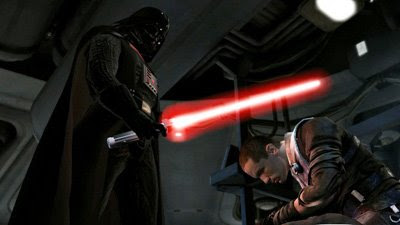
It certainly makes a good first showing.  Visually, you've never seen the Star Wars universe like this before.  Everything is beautifully lit and immaculately textured, and the environments immediately feel right.  Old stuff is painstakingly recreated, new stuff is carefully designed and fits in well.  It's a good job that the game looks so beautiful too, because a major portion of the gameplay involves smashing up and tearing down this remarkable vision.  Much has been made of The Force Unleashed's revolutionary technology, in particular the Digital Molecular Matter tech which causes the environment to deform in realistic ways.  I couldn't begin to tell you how it works, all I know is that it does, and it looks astonishing.  Metal bends, glass shatters, wood splinters and all hell breaks loose as the environment is radically altered with extreme force.  Nowhere is this better demonstrated than in the game's bravura prologue, in which you take control of none other than Darth Vader himself.  Tasked with clearing out a Wookiee village, and armed with your lightsaber and a full complement of turbo-charged force powers, incredibly fun havoc ensue.  The entire level is an onslaught of  satisfying destruction, throwing massive boulders through treehouses or blasting down enormous barricades.  The opening highlights everything that is great about Force Unleashed, the impressive visuals, the visceral gameplay, the outstanding environments and the overall 'Star-Warsiness' of the experience combining to deliver a showcase of gaming at its very best.  Sadly, it's sort of downhill from there.


This is what we like to see

The first problem occurs when the game proper begins and you take control of the main protagonist, Darth Vader's secret apprentice Starkiller.  Running into the first room, you get ready to let slip your astonishing force powers, only to discover that most of them have gone.  It's not so much the Force unleashed as the force mildly contained, and l
leads to a huge overreliance on  throwing boxes around, making the game feel like a lightly more polished version of Psi-Ops.  You can also attack with your lightsaber, but again, you've got practically no combos at this point, so it descends into mindless button-mashing.  The idea of a 'look what's possible' teaser is good in concept, but translates to a letdown in reality.  The idea of stripping you of your powers is to implement an RPG style 'level up and choose your talents' progression, which again is interesting in theory but redundant in reality, since the game itself will only dole out new powers at certain points and some upgrades are noticeably more useful than others.
Combined with the lack of power is the creeping feel of uninspired level design.  Though immaculately detailed, level design tends towards the repetitive, often falling into the dreaded 'series of rooms and corridors'. The large number of level set in starships/space stations/industrial facilities doesn't help either. Furthermore, realising that your powers make you nearly unstoppable in small scale skirmishes, the developers have chosen to instead throw dozens of enemies at you at once in huge battle chambers, often reducing the situation to a 'kill everything to get out' model.  Though this is rarely difficult (in fact the game generally is slightly on the easy side) it can be hugely frustrating, particularly when later enemies either resist your powers or can keep you a long way away with uncannily accurate projectiles.  Combat is particularly wearisome during boss battles, where the camera inexplicably assumes a locked perspective that is rarely ideal.  Nowhere are the failures in design highlighted batter than the infamous sequence where Starkiller pulls a Star Destroyer out of the sky.  What should have been the game's defining moment instead becomes an exercise in frustration as you're constantly interrupted from the spectacle by irksome enemies.


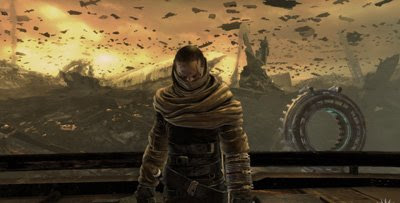
For a junkyard, the world of Raxus Prime is astonishingly atmospheric


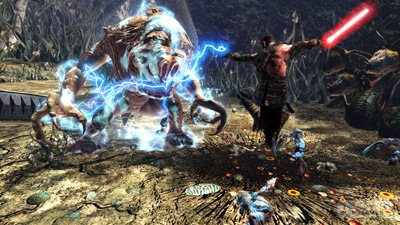
Despite all the griping however, there is a very fine game within.  Although the environments can often be uninspired, they are never less than beautiful.  The junk planet of Raxus Prime is a superb example of how to do an apocalyptic wasteland right, its mustard sky and rusted landscape an oddly beautiful setting.  And once you crank your force powers up a few notches, the game regains some of its blood and thunder and becomes massive fun to play.  Throwing screaming stormtroopers into an abyss or blasting rancors with force lightning is a pleasure every time, and the terrific feedback that the game world gives never gets old.  There's a few big surprises as well, the first being how replayable the game is.  Your powers and abilities carry over to a new game, so you can monster the early levels with maxed out force powers, and while the game is totally linear, the unpredictable nature of the battles mean that every new fight is fresh.  Hidden holocrons unlock goodies such as new costumes and lightsabers, giving an item hunt aspect to old levels.

The other big surprise is the story, which is deep, interesting and surprisingly relevant to the rest of the Star Wars universe.  It's fair to say that what happens in the game adds a significant dimension to the events of the original trilogy.  Bar the predictable and predictably rubbish love story, the narrative is strong and the voice acting excellent.  There's old faces aplenty (including one gleefully out of place cameo) and a few great new characters.  Special mention goes to PROXY, the Apprentice's loyal droid sidekick who has been programmed to try and kill him at every available opportunity.

In summary then, it's a missed opportunity, a flawed gem.  The game reminds me a lot of Assassin's Creed - technically superb, and with moments of genius, but ultimately held back from greatness by failure on some of the most basic levels.  There's no excusing some of the poor design in Force Unleashed, nor the frustration and repetition involved therein.  Equally, there's no denying how fun it is at it's very best.  The deep and through integration of the Star Wars universe earns it an extra point from me, but at the end of the day this is an entertaining toy rather than the new dawn we were hoping for.

[7]

Tuesday, 9 September 2008

Time and Mystery - Braid review


Braid is probably one of the hardest games to pin down in a long, long time. In short, it's a 2D-side scrolling platformer, except that it isn't. It's actually a fiendishly intricate puzzle game, a series of self-contained challenges. A puzzle game that is, however, themed around a fairy tale search for a princess, in the best traditions of an epic quest. But that seemingly simple story is in fact an allegory for the fleetingness of time, the contradictory nature of love and the creation of the atomic bomb. Then again, everything I've said may just have been total bollocks.

All of those statements are open to debate to a certain degree, and this is the fascinating and yet frustrating thing about Braid. It is maddeningly ambiguous, from it's play style to it's story and it's themes.

Let's start simple then. What is undeniable is that Braid is a very pretty game. It's drawn from a traditional 2D perspective, but uses a thickly daubed lineart style, with the backgrounds being washed out watercolours. Rendered in HD it's utterly gorgeous, and is complemented perfectly by the music, a selection of classical string quartet pieces.
Things only start to get difficult when you try and describe the gameplay. At it's root it's pure Mario, move from left to right and jump on things to kill them. The only major difference here is that you have a 'rewind' button, allowing you to turn back time Prince of Persia style. That's where the similarities end however. The first major difference here is that your rewind power is infinite and unlimited. Death therefore becomes simply a minor inconvenience. This in turn leads to the major point of the game. 'Completing' the levels is not difficult, but the point of playing is to collect the jigsaw puzzle pieces that lay scattered around the environments, and these often lie in seemingly inaccessible locations. the only way to obtain them is to use your time-bending powers to manipulate the environment to your advantage.
This then, is where the puzzle aspect lies. The game introduces several ideas that alter the game's timeflow, but the most basic is the idea that objects outlined in green are unaffected by your rewinding power. So in a very basic example, you can use a key to open a green outlined door, then rewind so that the key is in your hand again, but the door remains open. From this basic concept the game spins some of the most astonishing puzzles ever imagined, with concepts so insane you'll have to wring your brain out to solve them. These are often accompanied by changes in the world in which you're in, for example the world in which time stands still when you do, advances when you move right and rewinds when you move left. It's important not to understate the ferocity and brilliance of the puzzles, they really are amazing and had they been incorporated into any other game they would have been the standout feature. But not here.

Braid has been much compared to Portal, and the comparison is extremely valid, not only because they are both extremely clever puzzle games that used a dimension (space and time) in a new way, but because both offered more than that - namely a tangible narrative that connected players to the experience beyond the technical. Braid's is told through a series of textual excerpts at the beginning of levels. These are long, and use clever and elaborate language, often asking interesting questions and raising valid ideas, but they are also clunky and come off as rather pretentious. Much more effective is the gradual tonal shift throughout the levels, as they gradually become darker and more gothic, and the subtle hints given through the narrative that all may not be as it seems. These ideas only really pull together in the final hour, leading to one of the best final levels ever seen in games, and that is not an exaggeration. The elaborate dialogue is junked in favour of a chapter told entirely through the gameplay, with a shocking twist leading to an impossibly tragic conclusion. It's a mark of Braid's mastery that it not only manages this bravura slice of innovation but also manages to evoke more powerful emotions from a 2D platformer than from almost every 'cinematic' game ever made.
What follows this incredible ending is a beautifully baffling conclusion that fails to provide any sort of closure or any answers at all, ultimately leaving you (literally) right back where you started. In many ways this seems to be the point. The game deliberately makes it's point vague and non-specific, and it's unclear whether the story is genuine, partly imagined or entirely allegorical. It's a story which leads and captivates through intangibles such as mood, curiosity and emotion. And despite it's great technical and aesthetic achievements, that is perhaps what is the most amazing thing about this wholly remarkable game.

9/10

Sunday, 20 July 2008

A Trick up your Sleeve - Devil May Cry 4 review


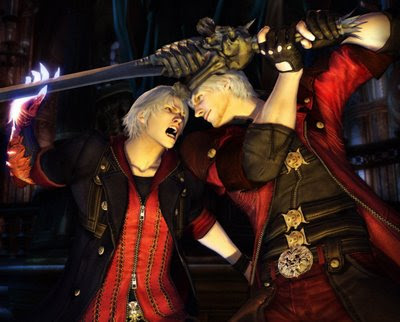
Devil May Cry is a hugely divisive series in videogaming. Many love it for it's old school score-attack mechanics, intricately gothic design, deep and complicated fighting style and outrageous camp, and predictably, many hate it for those exact same reasons. It hasn't helped that the series has been so wildly inconsistent, with the excellent original followed up by an awful sequel and a third game that was so infamously hard it was re-released just to neuter the difficulty. So combined with the shift to new hardware, this fourth game marks something of a rebirth for the series, and oddly enough it does this by ditching one of it's most appealing aspects, it's cocksure antihero Dante, recasting him as the game's antagonist. In his place is a new protagonist named Nero, a younger, more serious and angry character. This shift is mirrored in the general tone of the game, which adopts a far more serious, epic and artistic style than the moody darkness of previous DMC's, with ancient temples and demonic towers replaced by snowbound castles and sun-dappled forests. The visual design is spectacular and when allied to a powerful graphics engine the result is a game which is often stunningly beautiful, both statically and in motion
Nero doesn't just revitalise the look and feel of the game, but it's whole style of play as well. Although his sword 'n' gun attacks are similar to Dante, his moveset is reduced in favour of a new toy, his possessed arm, known as the Devil Bringer. This allows long-range grabs and powerful close quarters throws, meaning combo chains can be kept going for longer and the guard of enemies can be more easily broken. Although it initially feels cheap, with time and the introduction of harder enemies the balance is just right, and combined with the new 'Exceed' system, which allows Nero to rev up his sword for extra damage, it can lead to spectacular chains of attacks in trained hands. By the mid-point of the game, controlling Nero feels instinctive and exciting, with the player effortlessly dishing out huge combos and epic juggles. Which is why it's such a shock when it's all suddenly taken away.
Without wishing to get too spoileriffic, it's fair to say Nero suddenly becomes incapacitated, which means Dante, who up until this point has appeared only as an enemy, suddenly takes over as the main playable character. The stylistic shift is not total, but it takes a good while to get used to. As in DMC3 Dante has four separate styles of fighting, Swordmaster, Gunslinger, Trickster and Royal Guard. Each accentuates a different aspect of combat, and each adds a different set of moves on top of Dante's basic skillset. The net result of this is that Dante has huge variety of moves available to him (and we're not even considering the alternate weapons yet), and combined with his obvious lack of Devil Bringer attacks, he's a much deeper and more difficult character to play as. For a while - quite a long while actually - this irritates as you're forced not just to relearn movesets but to retailor your entire fighting style. But gradually, another feeling emerges - the feeling that the training wheels have been taken off. There's a lot more variety available with Dante, as well as the ability to mix up your styles for more grandstanding kills. Further sweetening the pill is Dante's ludicrous selection of weapons. The undoubted show-stealer is Pandora, a cursed briefcase that transforms into a variety of other forms, such as rocket launchers and laser cannons, and ultimately into a giant floating missile platform that rains spectacular death on nearby enemies.

'Overkill' springs to mind

There remains a lot to criticise about the game, most obviously the terrible environment recycling (Dante's levels are just Nero's levels in reverse) and the archaic backtracking and forced puzzles. And while the bosses are hugely spectacular and great fun to fight, that doesn't quite justify their inclusion three times. The camera is often flawed and can't decide whether it wants to be fixed or player controlled, often copping out and offering a weak mix of the two. Yet despite these totally valid criticisms there's something inherently lovable about the the game. I mentioned near the beginning that this is a more serious, mature Devil May Cry, and that's true, but we are speaking in relative terms here, and you've still got cutscenes filmed by an anime fanboy and dialogue written by a pantomime director. Particularly once Dante enters, the game practically implants its tongue in its cheek, with several scenes in particular raising the bar for hammy dialogue (to those in the know, I'll simply say "I'm here to reclaim what is rightfully mine!").
Overall then, this is a big, brutal, lovable beast of a game. It doesn't claim to be be clever, in fact it often goes out of it's way to prove it isn't, but the core appeal still lies there. Only now, it's smart as well, it's difficulty curve perfectly pitched, it's story touching and interesting as well as funny and silly and it's core gameplay just as challenging and rewarding as it ever was. It isn't perfect, but you'll be having so much fun you won't care

8/10

Thursday, 17 April 2008

Nothing is True - Review: Assassin's Creed Director's Cut

It's been a long time since I've anticipated a game so much, and equally long since I've been so baffled about my reaction to one. It's a testimony to Assassin's Creed that it can elicit such a complex response, as for better or worse, this is one of the most interesting and elusive games I've played in quite a while. The premise is reasonably simple - you are a medieval assassin, tasked with killing 9 important historical figures across three open world cities - but buried beneath are layers which are often bafflingly complex.
Good stuff first then - the game is gobsmackingly gorgeous, with some of the finest lighting and texturing work ever seen. Similarly, lead character Altair is also a triumph, this time of animation, his every leap, bound and movement choreographed to a tee, so for the first time a character in a video game moves like somebody who is truly alive.
Assassin's Creed also offers a fairly unique setting in gaming terms, namely that of the holy land circa the era of the third crusade. Emanating from this are the game's three main cities of Jerusalem, Damascus and Acre. These cities are arguably the game's greatest achievement, vast, highly detailed, and teeming with people. The cities truly feel alive, and walking their streets and prowling their rooftops it's easy to become immersed in their culture and communities.
That aforementioned walking and prowling is easy due to a clever set of controls that allow for great flexibility in your movement and fighting. Basically, Altair can be triggered between low profile, in which his movements are subtle and restrained, and high profile, where he becomes an acrobatic killing machine. In high profile mode he skips effortlessly across beams and scrambles up walls, while in low profile he stalks the streets silently, blending into the crowd.
It's perhaps mission structure where the game shows the first signs of stumbling. The 'investigations' you undertake to scout out your target are interesting to begin with, but they remain exactly the same throughout all nine killings. The assassination attempts themselves are refreshingly open, but too often degenerate into mass brawls where you can kill the target almost by accident. And the game suffers badly towards the end, as it descends into a series of uninspired melee battles and abandons it's open world ethos. The ending in particular feels rushed and ends on the worst cliffhanger since Halo 2, basically as if somebody had arbritarily cut the game midway through. It leaves the player utterly baffled and cheated.
Despite this, my love for the game burns undiminished. It's not the more conventional videogame aspects such as the missions which make the game great, more the sense of immersion into an entirely different world. Similarly to GTA, the greatest moments in this game are those of your own making, be it a frantic chase through the markets of Damascus, crowds scattering everywhere, or a lonely climb to the cathedral spire in Acre, giving breathtaking views over the entire city. In short, the game may not suceed on every level of traditional videogame standards, but as an experience it is unique and a triumph.

8/10

Wednesday, 12 March 2008

Here comes Justice

So I'm a big Ace Attorney fan. And I mean really really big. And that's the reason why I had Apollo Justice:Ace Attorney imported from the States before Euro release. Having devoured it in two days straight, I've got some interesting things to say about this supposed reboot of the franchise. Namely that it isn't even a reboot at all. OK, so it's got shiny upgraded sprites, new 3D sequences and some DS specific features, but crucially these are taken far less advantage of than you might think. In fact, it seems as though the level of interactivity has actually taken a step back from Capcom's last effort at a DS Ace Attorney, namely the truly outstanding extra case that was included with the English language version of the original game. Intriguing and original concepts do pop up, most noticeably a very neat X-Ray machine minigame, but these are absurdly underused.

The other main problem with the game is the characterization, unusual as creating memorable characters has always been a forte of the previous games. And to a certain extent, that's the problem here. Previous games introduced us to such a compelling cast of individuals that shrugging them off here is a big issue. Apollo himself and his assistant Trucy are straight cyphers of Phoenix and Maya, and the rest of the cast simply doesn't click so well. Major culprit in this case is the new prosecutor, Klavier Gavin. He's a perfectly good and interesting character, but he lacks the nasty, spiteful edge that previous prosecutors brought to the courtroom, and as a result, you never really feel any enmity towards him.

Having Phoenix Wright himself around doesn't really help break the mould either. He appears in every case in some capacity, and the overarching story arc also focuses on his fall from grace. In fact (SPOILER ALERT!) by the last case, the game drops all pretence and actually morphs back into a Phoenix Wright game (brilliantly the scenes set in flashback are downscaled to use old-school sprites), via some truly bizarre moments where the fourth wall is totally broken.(END SPOILERS)


So that's quite a lot of words ranting off against a series I profess to love. So here's the real kicker.

The game is brilliant

Despite everything I've said above, it retains all of the series's fantastic trademarks, namely terrific scripting (very well localized indeed), a genuine sense of tension and drama in the courtroom and some of the finest, most gripping stories ever told in games. It's one of the few games you can laugh out loud at one minute and then be deadly serious about the next.
So my final thoughts? The game is a missed opportunity for sure. But it still plays to the strengths of the series, and remains a brilliantly written and executed slice of adventure gaming. And that's good enough for me.

Tuesday, 4 March 2008

Dog of War or Cog of War?

It so happens that for the past week I've mostly been playing two games that end with 'of War'. Firstly, there's God of War, a title that's been languishing on my pile of shame for quite some time now. I actually picked it up about a year ago and got about halfway through the game, but then other shiny things distracted me. This time however, I ploughed all the way through in half a dozen sittings. It's a spectacularly visceral game, in more ways than just visually, although nobody could be disappointed with the amount of dismemberments, decapitations and all round bloodletting involved. The controls are tight and responsive, with excellent use of pad rumble and the combo system walks the line between simple and complex very well, allowing even cack-handed idiots like myself to chain in spectacular sequences extending into the hundreds of hits.
It's not all about the combat though, as the level design extends to some truly brilliant puzzles, especially the fiendish Rings of Pandora, where almost a third of the game is one huge puzzle. There are some decent platforming sections as well, although there's one particular platform bit near the end, involving rotating towers of blades, which deserves to be buried and never brought to light. This aside however, the game is truly a masterpiece of polish, with some of the most epic scenes imaginable. Glorious graphics, and a complex meandering storyline, making outstanding use of its inspired ancient Greek setting, provide some truly special moments, like seeing the Titan Chronos emerge out of the desert with a mountain strapped to his back, or reading the ramblings of the temple's architect as he slowly loses everything, including his sanity, to accomplish his work. One infamously immature moment aside, the game is also a great lesson in how to make a violent and explicit game which nevertheless uses these factors to it's advantage. In short, it's a masterpiece, and the second installment is high on my must buy list.

The second game I've been playing is the beer drinking fratboy's favourite, Gears Of War, and that opening sentence sums up my attitude to the game, more of which later. I'm late on the bandwagon for this one as well, but for good reason, namely that I physically cannot play shooters on consoles, so I've waited for a PC release. First impressions are good. The game runs well, and with a high resolution and plenty of processing, looks absolutely stunning.


This tends to happen a lot


It plays well too, the cover and popout controls adapting well to a keyboard. I'm only on the second chapter of the game at the moment, so I'll reserve judgment until the end as always, but at the moment, the firefights, weapons, terrain and level design are all top notch, while the story is rubbish, the atmosphere lacking and the chracterisation risible. And having said that I'm finding it terrific no brain fun. An open verdict on this one then, and I'll get back to you when it's done and dusted.