Monday, 9 February 2009

Demo impressions triple tag team! - Killzone 2, FEAR 2, Halo Wars


Killzone 2

Photobucket

The first thing that's worth saying is that Killzone 2 is probably the best looking thing ever to appear on a console from a purely technical standpoint.  The high level of detail genuinely brings atmosphere to the world, particularly the grit and grime, with dust in the air and surfaces realistically worn and chpped away. It lends the game a very brutalistic fell that's matched by the gameplay.  The chunky, realistic weapons, the decidedly non sci-fi settings and the slow paced combat, complete with a nicely clunky cover system conspire to make the pace of the game quite slow and the feeling very far away from the 'one man army' approach of supposed competitors like Halo.  Overall, it's fun to play but the whitewash of genericism, plus the reports coming in that the story is utter rubbish probably means I'll put off grabbing this one for some time.

FEAR 2: Project Origin

Photobucket

I was a huge fan of the first FEAR (full stops omitted because I'm lazy). I loved its spooky premise, its insane weapons and the gorgeous slow-mo combat that saw enemies pirouetting away in a hail of bullets, blood and masonry.  From this brief demo all those things seem intact, but there are a few caveats.  The graphics are certainly shinier, and the scares more sophisticated, but the truly outlandish aspects of the first game have been played down.  The shotgun, which was a god weapon in the first game, seems nerfed, which is probably a good thing if you're sensible, but I miss being able to dismember people with it.  And why have all the enemies suddenly turned into space marines? The mech section also feels hopelessly out of place to me, and overall although it's scary I miss the grim gritty tone that made the first FEAR (and the underrated Condemned) so compelling.  That being said, there was still lot's of good stuff in here, so I'll probably pick this one up in the late spring drought.

Halo Wars

Photobucket

I've always been a firm believer that the RTS is one of the genres that has no place on anything that doesn't have a mouse and keyboard.  Halo Wars has partially solved these problems howeever, by eliminating a great deal of the depth.  This is very much RTS lite, with base building stripped back to an absolute minimum, and the prevailing tactic once again being the rush (something which is acknowledged by the existance of a 'select all units' button).  But these are actually all good things, with the trade of instead being an emphasis on action and spectacle that fits nicely with the console platform and Halo license.  The two levels in this demo, are nicely packed with spectacle, hammy cutscenes and neat map design, and since I do tend to like my RTS's less complicated I think this one might be on my radar also.

Thursday, 5 February 2009

The world's latest best of 2008 post

I know this is very late.  Apologies, I'm trying to get back on the blogging train.

10 - Apollo Justice:Ace Attorney

Photobucket

No, it's not a notable evolution on the previous games.  But the Ace Attorney series has always delivered great gameplay and terrific soap opera storylines, and this is no exception.  And it is a Phoenix Wright game no matter what the title says, the trademark everything-and-the-kitchen-sink plotline returning and delving back into the storyline of our favourite spiky haired practitioner of the law.  As a franchise evolution, this needs serious work for its next instalment, but even without a major step onwards this is still one of the best interactive yarns you'll see this year.

9 - Super Smash Bros. Brawl

Photobucket

Yes, it's just a glorified fan game, but what fans and what a game.  Takes the anarchic sumo of Smash Bros. past and cranks up the insanity factor, which may or may not suit your taste.  Regardless, with an expanded roster, better level design and a raft of gameplay tweaks, including the new final smash attacks made this an outrageous, fast and heady experience.  The much touted singleplayer story mode was a letdown, and online play was totally broken, but a keen eye for detail and a great sense of free-for-all fun keeps this in here.

8 - Devil May Cry 4

Photobucket

This is one of the most stupid games ever released, an anachronistic throwback to a bygone age.  Fortunately, it knows this.  Instead, it chooses to put its efforts into its super slick graphics and a balanced and highly entertaining combat system.  The guns 'n' swords action is more balletic than ever before, new character Nero brings the action to the masses, while Dante provides depth and difficulty that the hardcore crave.  Combined with some striking level design and dialogue so horrifying it's hilarious, it produces a game which is no masterpiece, but is a fantastically enjoyable old school romp.

7 - Rock Band 2

Photobucket

The sequel gets the nod here, but really this is an endorsement for the whole rock band experience, regardless of platform or guise.  Harmonix took everything that made Guitar Hero so great and slipped it into a slicker, more grown up shell.  Adding in a superb song selection and friendly interface made the entire experience that much better, and there's still no better game to be played at a party.


6 - Burnout Paradise

Photobucket

I'm no big fan of driving games, but Criterion's latest is impossible to resist.  A huge, shiny mass of twisted metal and nitrous oxide, this is by far the best of the open-world racers, blending a hugley impressive city full of backstreets, junctions and improbable jumps with Burnout's trademark smash and crash racing.  Seamless online integration completed an excellent package, and generous downloadable content expanded the appeal and rightfully kept the game in the public eye.

5- No More Heroes

Photobucket

This could go 5 places either way and it would still polarise opinion.  There'll always be those who say that the abundant technical errors, grainy graphics and poorly realised open world break the immersion, and the repeated and repititive jobs and missions are simply no fun.  They'd probably be right.  There are also those who would proclaim that the outstanding characters, super sharp dialogue and irrepressible sense of style are enough to carry the game.  They're also right, since this is a game of deep flaws which you choose to ignore.  And if you can, there's a funny and clever experience like no other in here.  For better or worse, Suda51 at the height of his powers.

4 - Braid

Photobucket

The arguments that it is pretentious, that it is over-wordy and that it is deliberately and frustratingly impenetrable all hold true.  But it is so unlike anything else, and holds your attention and your interest far beyond its much talked about ending.  Beautiful and mechanically clever and deep, it deserves its much heralded status as the gem in a year of superb downloadable titles.

3 - Gears of War 2

Photobucket

I loathed the first GOW, so the fact that this ended up this high is a testament to its high quality.  Taking the stop-and-pop gameplay of the original, every single aspect is then scaled up to produce a gargantuan epic the scale of which has barely ever been seen in videogames.  Like the world's most expensive B-movie, giant worms, risible dialogue and some sledgehammer storytelling combine with endless spectacle to produce a rollercoaster ride of a game.  As far as third-person shooters go, this is the biggest, dumbest and best of them all.

2 - Prince of Persia

Photobucket

In any other year this would have won.  A game of endless polish and innovation, its revamped parkour makes it flow like no other platformer, while the new combat system suits well, neatly splitting the two parts of the game.  The much vaunted 'no death' mechanic slots in so well you'll wonder why it isn't in every game, and the plot reboot produces a pair of very different and but very likeable new protagonists, while the plot they're dropped into is clever and ambitious.  Add to that the fact that it's possibly the most beautiful videogame ever made, its fantastic environments and painterly backdrops creating a world of unparalleled visual glory, and you have a game that will go down as an instant classic.  The best game of the year.  Almost.

1 - Metal Gear Solid 4: Guns of the Patriots

Photobucket

Some would argue this isn't even a game.  They're wrong.  But they may have a point in the sense that it isn't the game parts of this experience that make it so special.  The revamped combat, the enhanced weapon loadout, the revamped controls, the repositioned camera, these all help, and they bump the purely game parts of it up to a very high standard indeed.  But really, it's the chance to immerse yourself in Kojima's world one last time, to see his beloved cast end their adventure together.  Long, pretentious and unwieldy, it is also a game of deep sorrow, a sad and tired game almost unique amongst all the games ever made.  Supplemented by astonishing production values, including amazing graphics, superb voices and outstanding music, this is less of a game, more of an experience.  And as experiences go, it is unmatched.


Wednesday, 7 January 2009

Curtain Call


By now I'm sure everyone has heard about this, but just to recap - UGO buys 1Up, cancels EGM, then proceeds to shutter 30 staff from the 1Up offices. Twitters and direct contact from the staff indicate that the long running 1Up show has also been cancelled, as have many/all of the site's beloved podcasts. The whole affair fills me with tremendous sadness. I've never met these people, never even been in the same state as them, yet I feel I knew them on some level. As the phrase going round the net says, they were 'the best friends I never met.' The staff of 1Up's honesty, friendly nature and willingness to have a laugh meant that they became more than just faceless journalists. Instead they became characters we could all relate to. Where else could you roll your eyes at Shane Bettenhausen's Sony fanboyism, or laugh at in- jokes about Nick Suttner's beard? Make no mistake, the journalism was top notch too, and the easygoing relationship with many figures in the industry meant that there was a relaxed informal air to interviews or scoops picked up. All I can say is that I'll miss all of them terribly. It'll be odd not to ride the train to work and hear Garnett say 'Weekend confirmed' into my headphones. I wish all of them the very best, and I've no doubt that they'll be back in the business soon enough. But a little part of what made games journalism special has died.

Monday, 22 September 2008

If only you knew the power of the Dark Side - The Force Unleashed review


Lucasarts have certainly set themselves a high bar with The Force Unleashed.  Combining cutting-edge videogame tech with a heavily scripted, canon-approved script, the game is the highest profile Star Wars release in years, and is tied into a larger campaign of toys, novels and comics just as Lucasarts did with Shadows Of the Empire many years ago.  At the heart of this however, lies the game itself.  There've been too many Star Wars games that have been all hype and no substance.  Can The Force Unleashed rise above this impression?
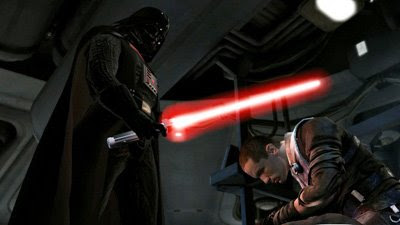
It certainly makes a good first showing.  Visually, you've never seen the Star Wars universe like this before.  Everything is beautifully lit and immaculately textured, and the environments immediately feel right.  Old stuff is painstakingly recreated, new stuff is carefully designed and fits in well.  It's a good job that the game looks so beautiful too, because a major portion of the gameplay involves smashing up and tearing down this remarkable vision.  Much has been made of The Force Unleashed's revolutionary technology, in particular the Digital Molecular Matter tech which causes the environment to deform in realistic ways.  I couldn't begin to tell you how it works, all I know is that it does, and it looks astonishing.  Metal bends, glass shatters, wood splinters and all hell breaks loose as the environment is radically altered with extreme force.  Nowhere is this better demonstrated than in the game's bravura prologue, in which you take control of none other than Darth Vader himself.  Tasked with clearing out a Wookiee village, and armed with your lightsaber and a full complement of turbo-charged force powers, incredibly fun havoc ensue.  The entire level is an onslaught of  satisfying destruction, throwing massive boulders through treehouses or blasting down enormous barricades.  The opening highlights everything that is great about Force Unleashed, the impressive visuals, the visceral gameplay, the outstanding environments and the overall 'Star-Warsiness' of the experience combining to deliver a showcase of gaming at its very best.  Sadly, it's sort of downhill from there.


This is what we like to see

The first problem occurs when the game proper begins and you take control of the main protagonist, Darth Vader's secret apprentice Starkiller.  Running into the first room, you get ready to let slip your astonishing force powers, only to discover that most of them have gone.  It's not so much the Force unleashed as the force mildly contained, and l
leads to a huge overreliance on  throwing boxes around, making the game feel like a lightly more polished version of Psi-Ops.  You can also attack with your lightsaber, but again, you've got practically no combos at this point, so it descends into mindless button-mashing.  The idea of a 'look what's possible' teaser is good in concept, but translates to a letdown in reality.  The idea of stripping you of your powers is to implement an RPG style 'level up and choose your talents' progression, which again is interesting in theory but redundant in reality, since the game itself will only dole out new powers at certain points and some upgrades are noticeably more useful than others.
Combined with the lack of power is the creeping feel of uninspired level design.  Though immaculately detailed, level design tends towards the repetitive, often falling into the dreaded 'series of rooms and corridors'. The large number of level set in starships/space stations/industrial facilities doesn't help either. Furthermore, realising that your powers make you nearly unstoppable in small scale skirmishes, the developers have chosen to instead throw dozens of enemies at you at once in huge battle chambers, often reducing the situation to a 'kill everything to get out' model.  Though this is rarely difficult (in fact the game generally is slightly on the easy side) it can be hugely frustrating, particularly when later enemies either resist your powers or can keep you a long way away with uncannily accurate projectiles.  Combat is particularly wearisome during boss battles, where the camera inexplicably assumes a locked perspective that is rarely ideal.  Nowhere are the failures in design highlighted batter than the infamous sequence where Starkiller pulls a Star Destroyer out of the sky.  What should have been the game's defining moment instead becomes an exercise in frustration as you're constantly interrupted from the spectacle by irksome enemies.


For a junkyard, the world of Raxus Prime is astonishingly atmospheric


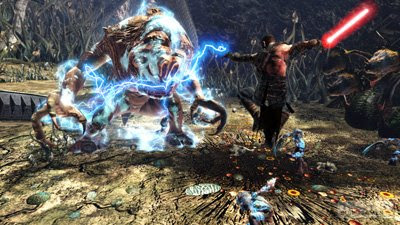
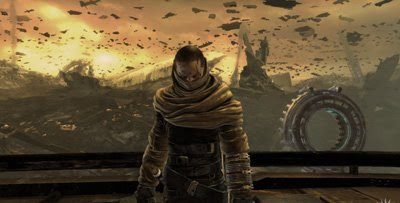
Despite all the griping however, there is a very fine game within.  Although the environments can often be uninspired, they are never less than beautiful.  The junk planet of Raxus Prime is a superb example of how to do an apocalyptic wasteland right, its mustard sky and rusted landscape an oddly beautiful setting.  And once you crank your force powers up a few notches, the game regains some of its blood and thunder and becomes massive fun to play.  Throwing screaming stormtroopers into an abyss or blasting rancors with force lightning is a pleasure every time, and the terrific feedback that the game world gives never gets old.  There's a few big surprises as well, the first being how replayable the game is.  Your powers and abilities carry over to a new game, so you can monster the early levels with maxed out force powers, and while the game is totally linear, the unpredictable nature of the battles mean that every new fight is fresh.  Hidden holocrons unlock goodies such as new costumes and lightsabers, giving an item hunt aspect to old levels.

The other big surprise is the story, which is deep, interesting and surprisingly relevant to the rest of the Star Wars universe.  It's fair to say that what happens in the game adds a significant dimension to the events of the original trilogy.  Bar the predictable and predictably rubbish love story, the narrative is strong and the voice acting excellent.  There's old faces aplenty (including one gleefully out of place cameo) and a few great new characters.  Special mention goes to PROXY, the Apprentice's loyal droid sidekick who has been programmed to try and kill him at every available opportunity.

In summary then, it's a missed opportunity, a flawed gem.  The game reminds me a lot of Assassin's Creed - technically superb, and with moments of genius, but ultimately held back from greatness by failure on some of the most basic levels.  There's no excusing some of the poor design in Force Unleashed, nor the frustration and repetition involved therein.  Equally, there's no denying how fun it is at it's very best.  The deep and through integration of the Star Wars universe earns it an extra point from me, but at the end of the day this is an entertaining toy rather than the new dawn we were hoping for.

[7]

Tuesday, 9 September 2008

'A little bit of magic' - The themes and mysteries of Braid


Braid has provoked more talk and discussion from the community than any title in a long time, partially over its fascinating and deliberately ambiguous themes. In this post I'm going to poke into them a little. Obviously spoilers are rampant after this point, ye be fairly warned.

SPOILERS

Although none of the themes of Braid are entirely clear, the most obvious one to me seems to be a commentary on the linear nature of time, and how humans do not necessarily perceive it as such. This is rooted in the game's basic mechanics of course, exemplified in its time manipulation gameplay, but is also highly prevalent in the surrounding text. Many passages talk of how time appears different to Tim than to others, and the text that opens the first level (world 2) in particular ruminates on how a less strictly linear progression would allow learning from mistakes without punishment. Directly attached to this is the idea that time progresses differently according to perspective, a theme which underpins the game's unique conclusion of course, but is also very clearly exemplified in World 6, where the ring which Tim carries is both a gameplay device but also an item of great emotional significance in the plot. Ultimately, the entire game hinges upon the concept of time and how it shapes our perception of those around us.
A second theme that I personally see within the game is an understanding that appearances are often deceiving. The 'princess' Tim is searching for may not actually even be a physical person, but rather an emotion or ideal, and in any case, she is actually actively fleeing from him. Remembering that the events of the final level take place chronologically before anything else in the game, so the Princess has already fled, and the entirety of your quest is futile, though you obviously don't know it until the end. Perhaps the most telling moment occurs at the end of world 6, which chronologically is the last moment in the game, where the dinosaur that emerges confesses that he has never even met the princess, before he asks the killer question 'Are you even sure she exists?'. The correct answer is of course 'No', since the princess has long vanished from the game. Her absence can be seen in the progression through the levels which become increasingly dark and damaged as you play through, possibly in direct correlation to the increasing distance of the princess. Of course, you'd be totally aware of this deception if you had seen the game's chronology correctly, which leads back to the idea that time is perceived differently depending on person and viewpoint.

As to the more specific details of the plot, I'm pretty much as clueless as anybody else. It's possible the entire idea of the narrative is as a Macguffin to carry the themes, a theory seemingly supported by comments made by creator Jonathan Blow. I'm not convinced, and I think that although the plot by no means has a traditional coherence there is more to it than a series of random statements. Based on the close, near obsessive nature of their relationship as described in the texts, plus the creepy nature of the final level (man waits outside womans bedroom, then chases her as she tries to stop him), I'm going to suggest a possible Tim-as-obsessed-stalker scenario. It explains his undying infatuation with her, as well as hinting at the 'mistake' that he made that he's striving so hard to eliminate. What if his mistake was merely meeting her? It also explains why he believes they had such a deep and meaningful relationship while she runs immediately at the sight of him, and the way that the game is a delusional 'quest' for someone who is already long gone. Theres plenty of holes, but it carries a certain logic and certainly adds a dark undertone.

The other common theory is that the entire narrative is actually an allegory for a real life event, namely the creation of the atom bomb. There's certainly plenty of evidence for this idea, most prominently the flaming city that opens the game and ultimately closes it (a set of twin towers is clearly visible from the attic, suggesting it's New York) as well as the direct quotes pulled from the epilogue. This idea recasts the role of the Princess not as a person but rather as an idea, a concept that seems within reach, but always keeps escaping at the last moment. I like the proposal, and it's certainly a bravura idea, but it also seems a little loose and takes no account of the text given outside of the epilogue.

Both of these ideas fail to take into account huge chunks of the game, and no explanation I've yet seen can do so. For example, what is the meaning of the four paintings built from the jigsaw pieces, which seemingly are totally disconnected from the plot in any sense (clearly the person in them is different every time, and is not Tim). The flags at the end of each world are apparently naval signals, what do they say and how do they fit into the levels? What, if any, is the significance of the dinosaurs? Nobody knows, and this is part of what makes Braid so fascinating. Like Lost, it's inscrutability provokes debate, and allows each player to create his own personal context and motivation for the game. Until Jonathan Blow reveals the purpose, if ever, Braid remains an mystery wrapped inside an enigma, and that only enhances it's lustre.

EDIT: Apparently, finding all the hidden stars in the game unlocks an alternate ending, which, suffice to say, seems to corroborate the 'bomb' theory. It certainly fills a major piece of the puzzle in.

Time and Mystery - Braid review


Braid is probably one of the hardest games to pin down in a long, long time. In short, it's a 2D-side scrolling platformer, except that it isn't. It's actually a fiendishly intricate puzzle game, a series of self-contained challenges. A puzzle game that is, however, themed around a fairy tale search for a princess, in the best traditions of an epic quest. But that seemingly simple story is in fact an allegory for the fleetingness of time, the contradictory nature of love and the creation of the atomic bomb. Then again, everything I've said may just have been total bollocks.

All of those statements are open to debate to a certain degree, and this is the fascinating and yet frustrating thing about Braid. It is maddeningly ambiguous, from it's play style to it's story and it's themes.

Let's start simple then. What is undeniable is that Braid is a very pretty game. It's drawn from a traditional 2D perspective, but uses a thickly daubed lineart style, with the backgrounds being washed out watercolours. Rendered in HD it's utterly gorgeous, and is complemented perfectly by the music, a selection of classical string quartet pieces.
Things only start to get difficult when you try and describe the gameplay. At it's root it's pure Mario, move from left to right and jump on things to kill them. The only major difference here is that you have a 'rewind' button, allowing you to turn back time Prince of Persia style. That's where the similarities end however. The first major difference here is that your rewind power is infinite and unlimited. Death therefore becomes simply a minor inconvenience. This in turn leads to the major point of the game. 'Completing' the levels is not difficult, but the point of playing is to collect the jigsaw puzzle pieces that lay scattered around the environments, and these often lie in seemingly inaccessible locations. the only way to obtain them is to use your time-bending powers to manipulate the environment to your advantage.
This then, is where the puzzle aspect lies. The game introduces several ideas that alter the game's timeflow, but the most basic is the idea that objects outlined in green are unaffected by your rewinding power. So in a very basic example, you can use a key to open a green outlined door, then rewind so that the key is in your hand again, but the door remains open. From this basic concept the game spins some of the most astonishing puzzles ever imagined, with concepts so insane you'll have to wring your brain out to solve them. These are often accompanied by changes in the world in which you're in, for example the world in which time stands still when you do, advances when you move right and rewinds when you move left. It's important not to understate the ferocity and brilliance of the puzzles, they really are amazing and had they been incorporated into any other game they would have been the standout feature. But not here.

Braid has been much compared to Portal, and the comparison is extremely valid, not only because they are both extremely clever puzzle games that used a dimension (space and time) in a new way, but because both offered more than that - namely a tangible narrative that connected players to the experience beyond the technical. Braid's is told through a series of textual excerpts at the beginning of levels. These are long, and use clever and elaborate language, often asking interesting questions and raising valid ideas, but they are also clunky and come off as rather pretentious. Much more effective is the gradual tonal shift throughout the levels, as they gradually become darker and more gothic, and the subtle hints given through the narrative that all may not be as it seems. These ideas only really pull together in the final hour, leading to one of the best final levels ever seen in games, and that is not an exaggeration. The elaborate dialogue is junked in favour of a chapter told entirely through the gameplay, with a shocking twist leading to an impossibly tragic conclusion. It's a mark of Braid's mastery that it not only manages this bravura slice of innovation but also manages to evoke more powerful emotions from a 2D platformer than from almost every 'cinematic' game ever made.
What follows this incredible ending is a beautifully baffling conclusion that fails to provide any sort of closure or any answers at all, ultimately leaving you (literally) right back where you started. In many ways this seems to be the point. The game deliberately makes it's point vague and non-specific, and it's unclear whether the story is genuine, partly imagined or entirely allegorical. It's a story which leads and captivates through intangibles such as mood, curiosity and emotion. And despite it's great technical and aesthetic achievements, that is perhaps what is the most amazing thing about this wholly remarkable game.

9/10

Monday, 18 August 2008

Welcome back to the stage of history - Soul Calibur IV review

Soul Calibur has always been my favourite series of fighting games for a number of reasons, namely the wonderfully unusual setting, and the gameplay, perfectly balanced between hardcore and more relaxed. By conservative estimate I poured more than a hundred hours into the original and also put in a fair share of time with the Gamecube version of Soul Calibur II, so the franchise and I have history.
First impressions of the title are good. It's graphically stunning, with the characters redesigned and remapped into amazing high-detail models. Backgrounds, clothing, weapons and animation are all top notch, and there's some genuinely clever level design, such as the circus level, set in a cage that can be gradually unfolded.
It's looking upon the character roster that doubts may initially set in. Soul Calibur III's character roster returns in full, when it arguably could have used some trimming. There's only two completely new characters, though they're both good. Pike and sword wielding fraulein Hilde brings an unique style to the table, while final boss Algol avoids the problem of badly balanced super-enemies (Jinpachi Mishima in Tekken 5 anyone?) and proves both powerful and fun to play.

Not broken, honest

The roster is bulked out by five characters designed by prominent anime artists, all of whom, are net designs, but use other characters movesets, so don't really count. Finally, there's the controversial inclusion of the Star Wars characters. Now look, I'm a huge Star Wars fan, and I haven't played the PS3 version, but Yoda and the Apprentice simply do not feel right here. Yoda is ridiculously difficult and ungainly to play, while the Apprentice is utterly broken and in the right hands (ie the AI's) can simply attack spam you to death.
Leaving that particular controversy behind, once in the ring the game plays beautifully as it always has. Minor tweaks have been made to improve the flow, and the brand new Critical Finish attack is both spectacular and useful, preventing turtling and encouraging a more open and attacking play style. Great for button-mashers but deep enough for dedicated players, the vast variety of styles mean the game is exciting to watch and to play.
One of the things I've always personally liked about Soul Calibur is that it has possibly the deepest and most interesting story and set of characters in the fighting genre. Many cast this aside as unnecessary, but I like anything that gives context within a game and thus was very fond of the elaborate story-cum-mission modes in the previous games which culminated in Soul Calibur III's hugely elaborate Tales of Souls mode. Unfortunately, these aspects have been slimmed down considerably, with Story mode being reduced to an extremely short series of battles and the new Tower of Lost Souls mode being nothing more than a glorified survival mode. There's little of the inventive objectives that made the originals' Mission mode so compelling, or the insight that Tales mode provided. In some sense, this is made up for by the generous online play, which works well. Lag is kept down, although obviously response time is nowhere near offline levels, and matchmaking is excellent, producing good battles.
There's one final ace up Soul Calibur IV's sleeve, and that's it's lavish character creation mode. You can either edit existing characters or create entirely new ones based on preassigned styles, and the breadth and depth of the customization options is huge. There's a ton of costume parts available from the outset, with more unlockable as you progress through the game, and everything from finely detailed armour to jester costumes are available, enabling your avatar to be as noble or ridiculous as desired. The character creation adds literally hours and hours to the game's lifespan, and it's flexibility is remarkable, as evidenced by some of the creations already out there.
Overall then, this is an evolutionary rather than revolutionary step for the series. Though it occasionally feels oddly under-featured, the core gameplay remains an untouchable strength, and the excellent presentation means that it's very enjoyable to play. Unlikely to hit the heights of perfection as the original so regularly did, it remains the best fighting game around.

7/10